Where to See Hippos in Uganda
Where to See Hippos in Uganda is a common question for travellers planning a wildlife safari, and fortunately, hippos are among the easier animals to encounter in the country’s parks. Uganda has numerous lakes and rivers that provide suitable habitat for hippos, but the largest concentrations are found in Queen Elizabeth National Park and Murchison Falls National Park.
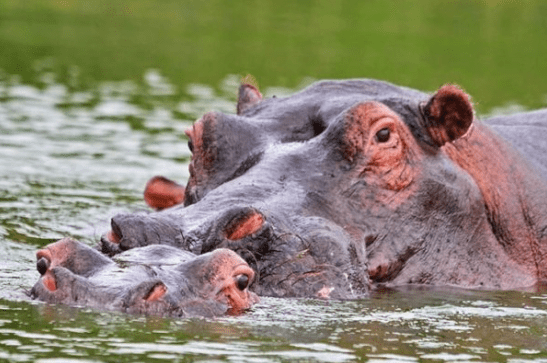
For many visitors, the best way to see them is from a boat. Watching dozens of hippos gathered in the water, with only their heads and backs visible above the surface, is one of the most memorable parts of a Uganda safari. A boat cruise also allows you to observe them from the water without disturbing them.
Queen Elizabeth National Park
Queen Elizabeth National Park is arguably the best-known destination for hippo viewing in Uganda. The park’s lakes, channels and wetlands provide ideal habitat, and more than 77% of Uganda’s recorded hippo population was found in the Queen Elizabeth Conservation Area during the 2023–2025 wildlife assessment.
The main attraction is the Kazinga Channel, which connects Lake George and Lake Edward. The channel is famous for its concentration of hippos, and a boat cruise gives visitors an excellent opportunity to see them gathered in and around the water.
Hippos can often be seen resting in groups during the day, while others remain partly submerged to keep cool. Along the channel, you may also see Nile crocodiles, elephants, buffaloes and numerous waterbirds.
This makes the Kazinga Channel more than simply a place to see hippos. It is one of the best wildlife-viewing experiences in western Uganda.
Kazinga Channel Boat Cruise
The Kazinga Channel Boat Cruise is one of the activities worth adding to a Queen Elizabeth safari if hippos are high on your list.
From the boat, you can observe hippos at relatively close range while remaining in the safety of the vessel. The channel’s shores are also busy with wildlife, so it is worth keeping your camera ready throughout the cruise.
Hippos are not the only attraction. Depending on the time and location, you can see elephants approaching the water, buffaloes along the shoreline, crocodiles lying in the sun and a remarkable variety of birds.
The experience is particularly enjoyable because you are not simply searching for wildlife. The animals are often already visible along the channel, creating a relaxed alternative to a traditional game drive.
Murchison Falls National Park
Murchison Falls National Park is another excellent destination for seeing hippos.
The Victoria Nile runs through the park before continuing towards Lake Albert, creating an important water source for wildlife. UWA notes that hippos and crocodiles are resident along the river and can be seen during boat trips towards Murchison Falls.
The classic boat cruise starts around Paraa and travels upriver towards the bottom of Murchison Falls. Along the way, passengers can watch hippos in the water and along the riverbanks, alongside elephants, buffaloes and other wildlife.
The setting is very different from the Kazinga Channel. Instead of a broad channel connecting two lakes, you are travelling along the Nile towards one of Uganda’s most spectacular natural landmarks.
A Murchison Falls boat safari therefore combines wildlife viewing with the opportunity to see the powerful waterfall from below.
Lake Mburo National Park
Lake Mburo National Park is another place where visitors can encounter hippos.
The park’s lake provides suitable habitat, and boat trips offer opportunities to see hippos around the shoreline and in the water. UWA’s latest wildlife assessment continues to monitor hippo populations in Lake Mburo alongside Queen Elizabeth and Murchison Falls.
Lake Mburo is particularly useful for travellers planning a shorter safari because it is relatively accessible from Kampala and can be incorporated into an itinerary through southwestern Uganda.
The park also offers a different safari atmosphere, with opportunities for game drives, nature walks and boat activities.
Why Are Hippos Usually in Water During the Day?
Hippos spend a large part of the day in water because it helps protect their sensitive skin from the sun and heat. They usually leave the water to feed on grass, often moving onto land in the evening or during the night.
Despite spending so much time in water, hippos are not strong swimmers in the way many people assume. They generally move through the water by walking or pushing themselves along the bottom rather than swimming normally.
This behaviour is one reason boat cruises are so effective for hippo viewing. During the daytime, large groups can often be found gathered in the water.
When Is the Best Time to See Hippos?
Hippos can be seen throughout the year, so there is no single season you have to visit Uganda to see them.
Daytime boat cruises are particularly good because hippos are generally resting in the water. On the Kazinga Channel, for example, you may encounter large groups lying close together, with some animals completely submerged except for their eyes, ears and nostrils.
Early morning and late afternoon can also be rewarding for wildlife viewing, especially if you combine a boat cruise with a game drive.
During dry periods, animals may become more concentrated around remaining water sources, which can sometimes make wildlife viewing easier. However, hippos are permanent residents of Uganda’s major waterways and are not dependent on a particular safari season.
Are Hippos Dangerous?
Hippos may look calm when they are floating in the water, but they are powerful wild animals and should never be approached casually.
They are territorial around water and can become aggressive if they feel threatened. This is especially important for visitors taking photographs or participating in activities near lakes and rivers.
During a boat cruise, always follow the instructions of the boat crew or guide. Never attempt to enter the water or move closer to a hippo for a photograph.
If you are taking part in a walking activity near a water source, your guide will determine a safe route and explain how to behave around wildlife.
How to Photograph Hippos on Safari
Hippos can make excellent wildlife photography subjects, particularly when several animals are gathered together.
On a boat cruise, a telephoto lens can help you capture close-up images without needing to move the boat unnecessarily close. Try photographing more than just the hippo’s face. Groups of hippos in the water, reflections and surrounding landscapes can create much more interesting photographs.
You may also catch moments when a hippo opens its enormous mouth, yawns or surfaces beside another animal.
Remember that the goal is to photograph wildlife without disturbing it. Your guide will know how close the boat can safely approach.
Which Is the Best Place to See Hippos in Uganda?
If hippos are your main priority, Queen Elizabeth National Park is the strongest choice, particularly because of the concentration around the Kazinga Channel. Uganda’s latest wildlife assessment recorded more than three-quarters of the national hippo population in the Queen Elizabeth Conservation Area.
Murchison Falls National Park is another excellent option, especially if you want to combine hippo viewing with a boat trip to the base of Murchison Falls.
Lake Mburo National Park is a good alternative for shorter itineraries and travellers exploring southwestern Uganda.
The best choice ultimately depends on your wider route. There is no need to plan an entire safari around hippos when these animals can be easily incorporated into a broader wildlife itinerary.